
The Nameless Coast
A Godot puzzle game that teaches Mandarin characters through exploration, context and inference rather than memorisation.
- Genre
- Puzzle / exploration
- Engine
- Godot
- Subject
- Mandarin (汉字)
- My role
- Design, development, art
Technologies
- Godot
- GDScript
- Python
- Game Design
- Language Learning
Project overview
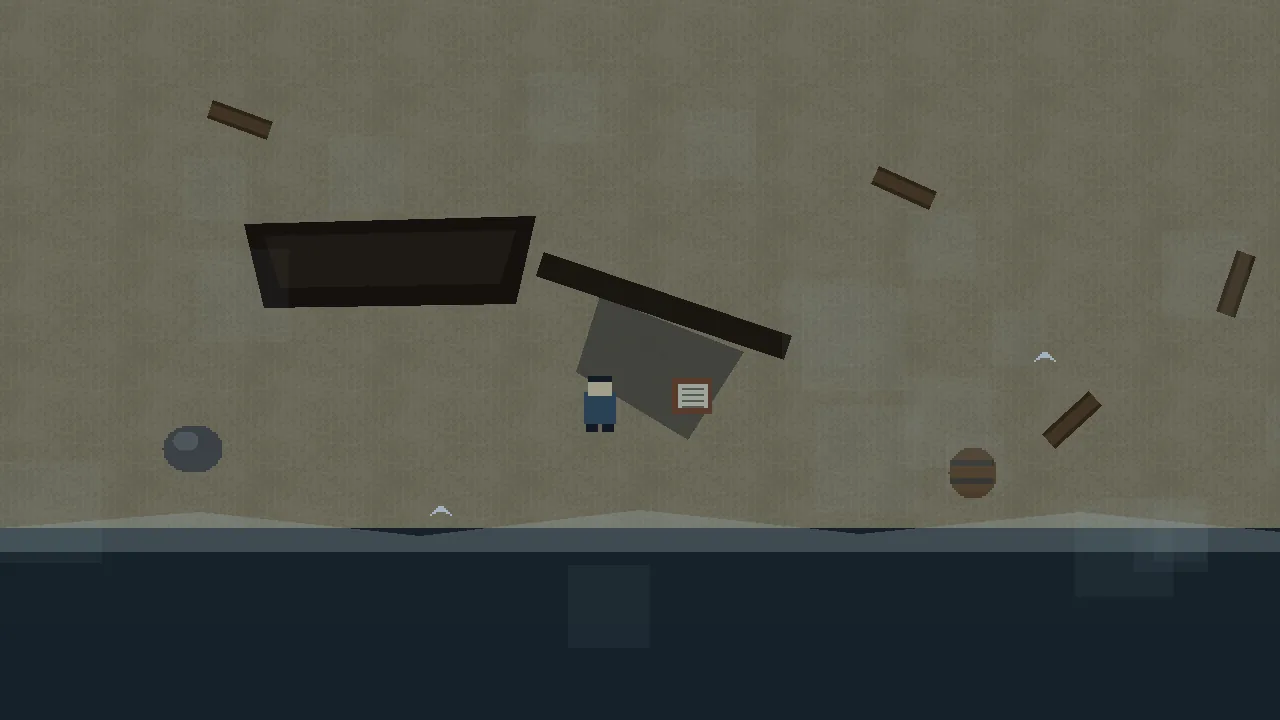
In my personal game project The Nameless Coast, the player wakes on an unfamiliar coast after a shipwreck. The marks on doors, temples and objects are never translated directly; the player infers their meaning from context and records each deciphered Mandarin character in an in-game journal.
No translation, only inference
Most language games show you a word and then quiz you on it. This one inverts that: you meet a character in the world first — above a door, on the rim of a bell, on a sign — and you work out what it means by solving the puzzle around it.
Each journal entry has a guess field: "what do you think it means?". Wrong answers cost nothing; the character simply stays undeciphered, and the next time you meet it in the world you gain one more piece of context.
That makes learning the progression mechanic rather than a by-product. If you cannot open the door, it is because you have not understood the mark on it yet.
The journal
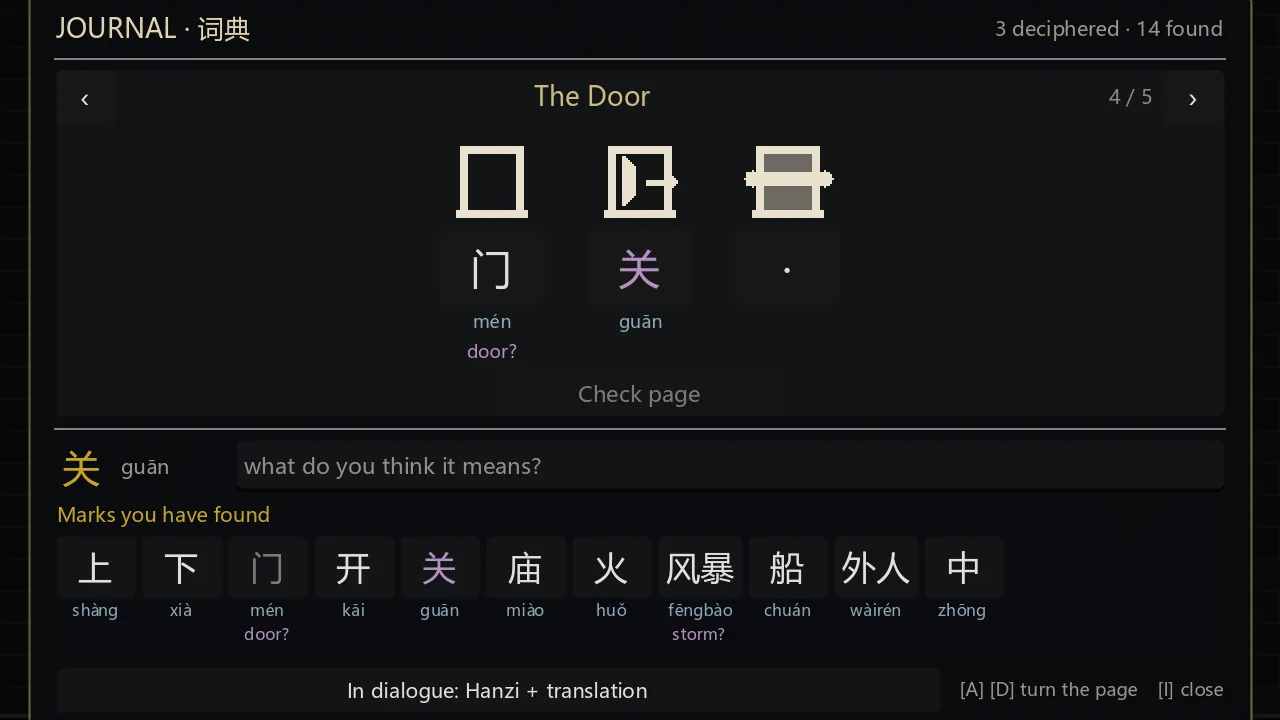
The journal (词典) is the game’s only interface. Every mark you find collects here: 上, 下, 门, 开, 关, 庙, 火, 风暴, 船, 外人, 中…
A counter at the top reads something like "3 deciphered · 14 found". The distinction is deliberate: having seen something is not the same as having understood it.
Pages are grouped thematically. On the "The Door" page 门 and 关 sit side by side, because seeing them together explains both — one gives you the object, the other the action performed on it.
The coast
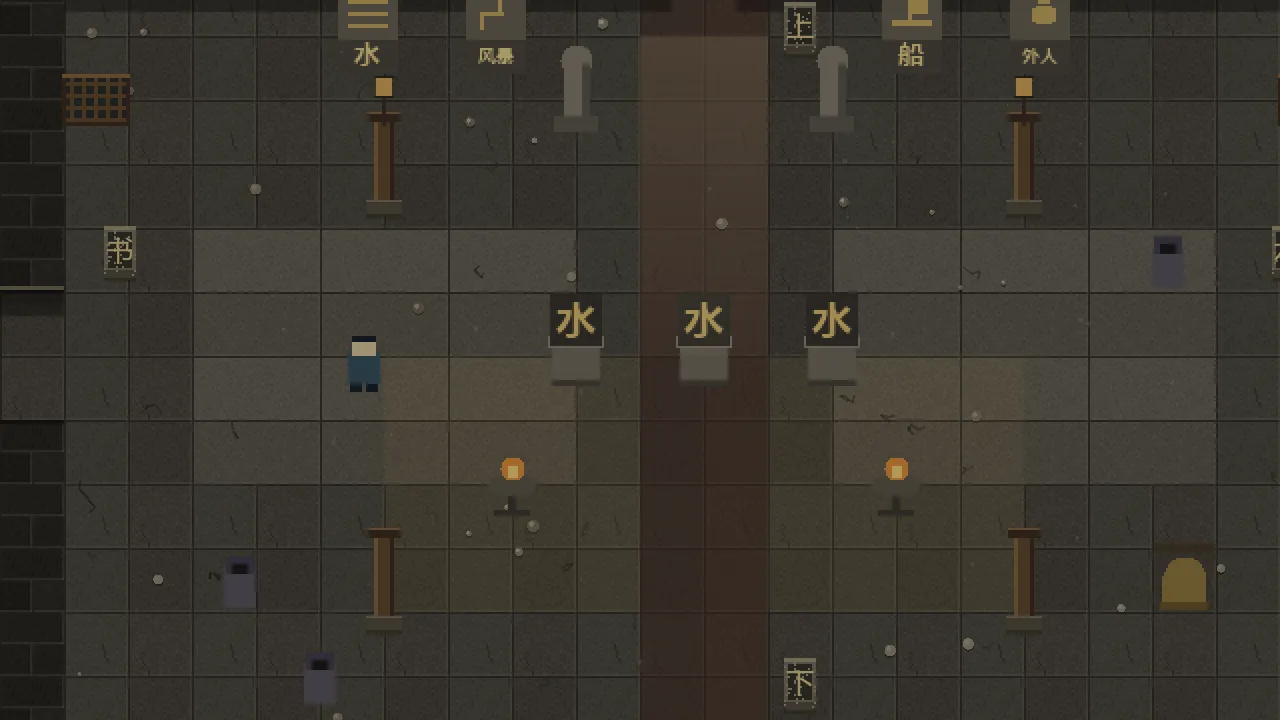
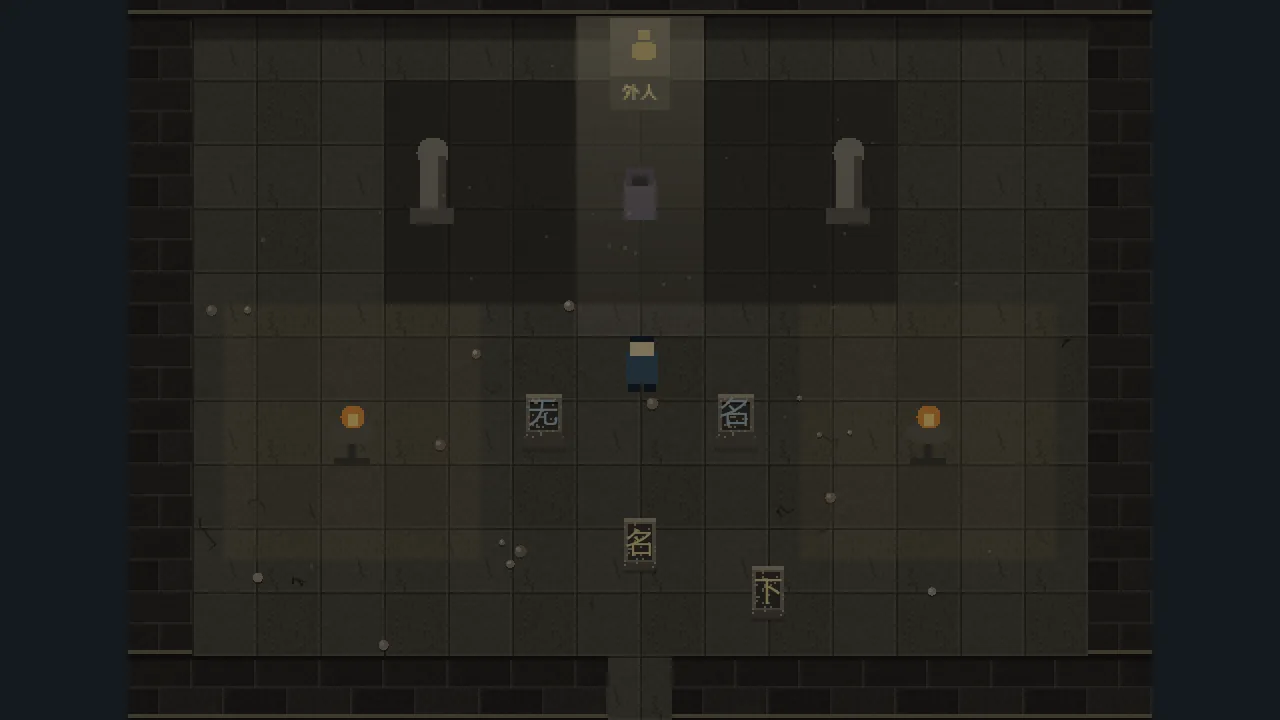
Locations are designed around the words they teach. The beach opens on wreckage — that is where 船 and 风暴 come from. The hall and the temple doors teach the trio 门, 开, 关. The bell only makes sense towards the end, once you can actually read the marks.
The visual language is deliberately quiet: washed-out sand tones, dark interiors, backgrounds that do not compete for attention. I wanted the marks to be the only thing on screen asking to be read.
Why Mandarin
Hanzi lend themselves to being a game mechanic: each character is a visual puzzle on its own, and its parts recur inside other characters. Once you understand 门, every character containing 门 hands you a clue.
This would not work for a language written in the Latin alphabet — you either know the word or you don’t. With hanzi there is a middle zone, "I can see its structure but not its meaning", and the entire game lives in exactly that zone.
Godot and the process
I am building the game in Godot. The journal system turned out to be the hardest part: it has to track the state of every mark found in the world, store guesses, and present the same character in different contexts across different locations.
I also document the process on my YouTube channel. I find it more useful to explain why a design decision changed than to show a finished feature.
Other projects
- AISiteMindA RAG-powered AI assistant that retrieves relevant information from websites and user-provided content and turns it into structured answers.View project
- RoboticsMartı-IIIA fixed-wing UAV that reached the final stage of TEKNOFEST, for which I designed the 3D model and contributed to autopilot configuration.View project
- WebMir HoldingA responsive, bilingual corporate website whose initial version I built and launched as the sole developer.View project