
HayattaKAL
A TEKNOFEST demo that uses Gemini to guide patients towards an appropriate department, with software development led by me.

- Competition
- TEKNOFEST — AI in Healthcare
- Result
- Online presentation stage
- My role
- Team founder & software lead
Technologies
- Next.js
- TypeScript
- Tailwind CSS
- Python
- Gemini API
Project overview
For the 2024 TEKNOFEST AI in Healthcare Competition, I founded a team and led software development. In our demo, patients complete a structured pre-assessment before booking; Gemini evaluates that information without making a diagnosis and offers guidance towards an appropriate department. The project reached the online presentation stage.
The problem: appointments carry no information
When a patient books an appointment, all the system receives is a date and a department. What the complaint is, how long it has lasted, which medications are involved — all of it gets asked from scratch in the first minutes of the consultation.
Worse, patients usually pick the department by guessing. An appointment booked into the wrong department wastes both the patient’s time and the system’s capacity.
Our starting point was this: the patient already holds the information, it is just collected at the wrong moment and nobody uses it for routing.
Routing with the Gemini API
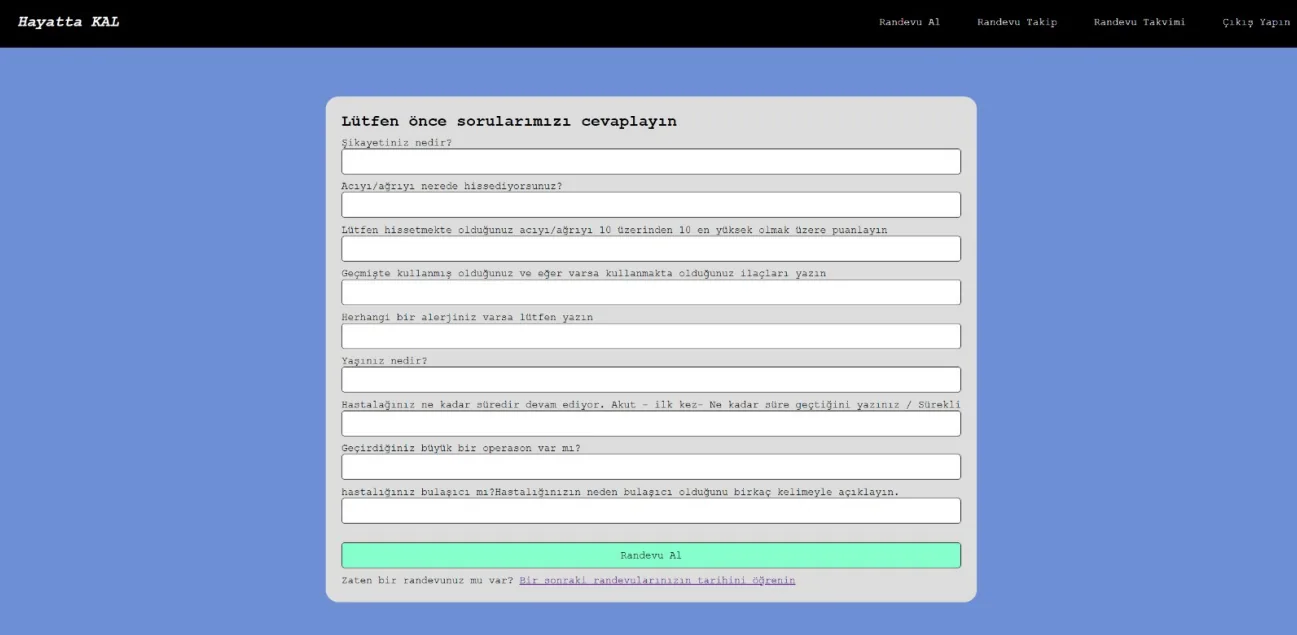
In the demo, a structured form comes before booking: what the complaint is, where the pain is felt, its severity out of ten, past and current medications, allergies, age, how long it has lasted and whether it is acute, any major operations, and whether the condition might be contagious.
Those answers go to the Gemini API, which offers guidance towards an appropriate department. We explicitly kept diagnosis out of scope; the goal was decision support that makes pre-appointment information more structured and useful.
The contagion question was there on purpose: a contagious complaint changes not only when an appointment is scheduled but how.
The system had three flows — booking, tracking and a calendar — so the pre-assessment became part of the patient’s own history rather than a one-off survey.
Founding a team, and knowing the scope
This was as much an organisational experience as a technical one. It was the first time I put an idea forward myself, gathered a team around it, split the work and managed the submission calendar.
Reaching the online presentation stage showed that the idea held up not only as a working demo but also in written and spoken form. It taught me how decisive it is to explain a problem clearly before building anything.
We never took on interface design; time was short and we prioritised showing the idea working. Looking back, I think in a demo the visual language is part of the argument too — that lesson came from this project.
Other projects
- AISiteMindA RAG-powered AI assistant that retrieves relevant information from websites and user-provided content and turns it into structured answers.View project
- GamesThe Nameless CoastA Godot puzzle game that teaches Mandarin characters through exploration, context and inference rather than memorisation.View project
- RoboticsMartı-IIIA fixed-wing UAV that reached the final stage of TEKNOFEST, for which I designed the 3D model and contributed to autopilot configuration.View project